How to read a price index
What a price index of 103 means, how it is calculated, why the index with shipping can tell a different story, and what to check before you act on it.
Corprice5 min read
A price index turns hundreds of individual price comparisons into one number per competitor. It answers a simple question: across the products we both sell, am I cheaper or dearer, and by how much? This guide explains how the number is built, how to read it, and the mistakes that make it misleading.
What the number means
The price index compares your price with a competitor’s price product by product, and averages the result. For each product you share:
index = 100 × your price ÷ their price
Then the average is taken over all shared products.
- 100 means you are at the same level.
- Above 100 means you are dearer. An index of 104 means your prices are on average 4 % above theirs.
- Below 100 means you are cheaper. An index of 96 means you are on average 4 % below.
Because it is a ratio, the index is the same whether you use prices with or without VAT, as long as both sides use the same basis.
A worked example
Example. Three products shared with one competitor. The prices are made up.
| Product | Your price | Their price | Index |
|---|---|---|---|
| Grinder | DKK 499 | DKK 479 | 104.2 |
| Espresso machine | DKK 1,299 | DKK 1,349 | 96.3 |
| Milk jug | DKK 249 | DKK 229 | 108.7 |
| Average | 103.1 |
Against this competitor your index is 103.1. On average you are about 3 % dearer.
Notice what the average hides. You are cheaper on the most expensive product and dearer on the two cheaper ones. Each product counts equally, so a DKK 249 milk jug moves the index as much as a DKK 1,299 machine. The index tells you about your price level across the range, not about revenue or margin.
One index per competitor, and one for the market
An index against a single shop tells you how you compare with that shop. A market index compares each of your products with the cheapest competitor on that product, whoever it is.
The market index is therefore usually higher than your index against any single shop. If your market index is 108 while your index against each competitor is between 98 and 104, it means different shops are cheapest on different products. No single competitor is beating you across the board, but on most products someone is.
With and without shipping
Shipping changes the picture, especially on cheaper products. An index with shipping adds the shipping cost on both sides before comparing.
Example. Same grinder as above. You ship it for free. The competitor charges DKK 39 for shipping.
- Without shipping: 100 × 499 ÷ 479 = 104.2. You look 4 % dearer.
- With shipping: 100 × 499 ÷ (479 + 39) = 100 × 499 ÷ 518 = 96.3. You are 4 % cheaper on what the customer actually pays.
If the two indexes point in different directions, the one with shipping is closer to what the customer sees at checkout. Read Shipping is part of the price for more on this.
Check what the index is based on
An index is only as good as the comparisons behind it. Before you act on it, check three things.
How many products are shared. An index of 112 based on four shared products says little about a competitor’s pricing. An index of 112 based on 400 products is a pattern.
Whether the matches are right. One wrong match, such as a single unit compared with a four-pack, can move an index on a small range by several points. See why matching by EAN beats matching by name.
Whether the prices are current. A price checked a month ago is not a competitor’s price today. Daily checks keep the index close to the market.
Read the line, not just the point
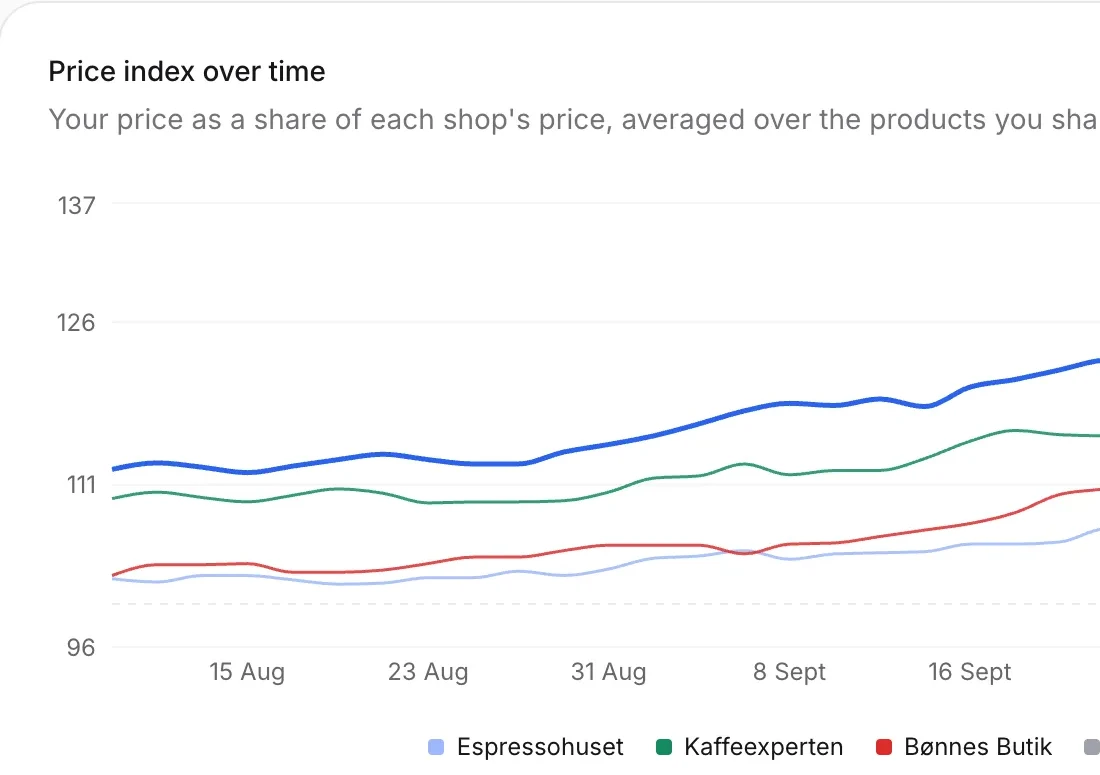
The index over time shows when your position changed. A rising line means you are getting dearer compared with that shop. That can happen for two different reasons:
- You raised your prices.
- They lowered theirs.
The index alone does not tell you which. Look at the price changes and campaigns behind the movement. A competitor campaign often shows as a step up in your index that drops back when the campaign ends. A slow, steady climb over weeks usually means a competitor is lowering prices product by product.
Look at the spread, not only the average
The same index can hide very different situations. An index of 102 can mean you are 2 % dearer on everything, or that you are 15 % dearer on a handful of products and level on the rest. The second case needs a different response.
Group the shared products by gap: more than 10 % cheaper, 3 to 10 % cheaper, roughly level, 3 to 10 % dearer, more than 10 % dearer. If most products sit in the middle and a few are far out, deal with those few products. If the whole distribution has shifted, it is a question of overall price level.
The index on the market page
Corprice calculates the index as 100 × your price ÷ their price, averaged over the products you share, for each competitor and for the market. There are two indexes, one without and one with shipping, where shipping is taken from the page or measured in the competitor’s basket.
Each competitor has its own page with the number of shared products, how many they are cheaper on, how the gaps spread from over 10 % cheaper to over 10 % dearer, and threats: products where they are at least 3 % below you. It also shows where you can raise your price and still be cheapest, in kroner. Campaigns, price drops and stock changes are recorded as events, so you can see what moved the line.
See the competitor analysis page for the full view.
A short checklist
- Read 100 as level, above as dearer, below as cheaper.
- Compare the index with and without shipping.
- Check how many products the index is based on.
- Look at the spread of gaps, not only the average.
- When the line moves, find out who moved.