Why matching by EAN beats matching by name
The same product has a different name in every shop. Why the barcode number is the safer way to compare prices, where it falls short, and what to do then.
Corprice4 min read
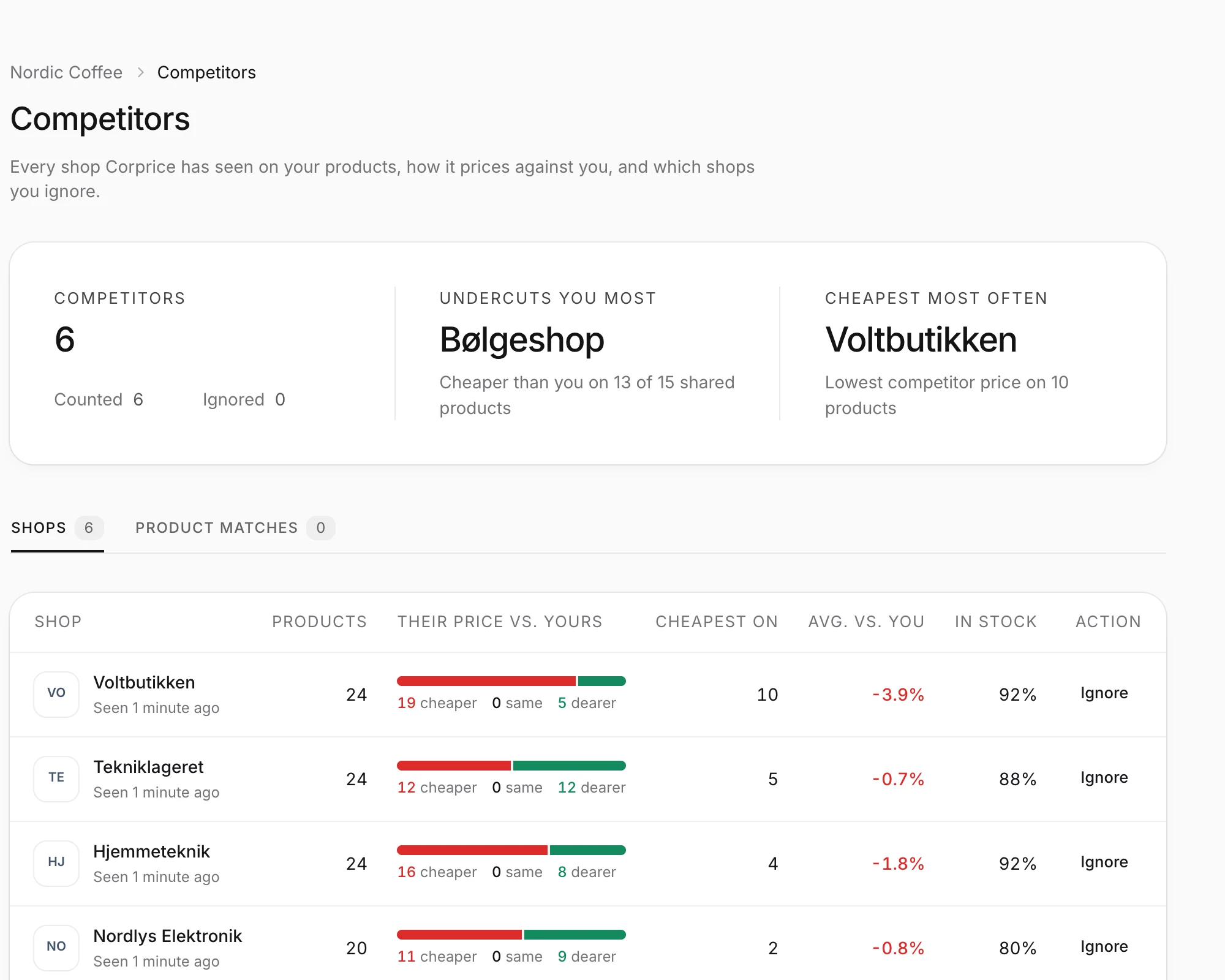
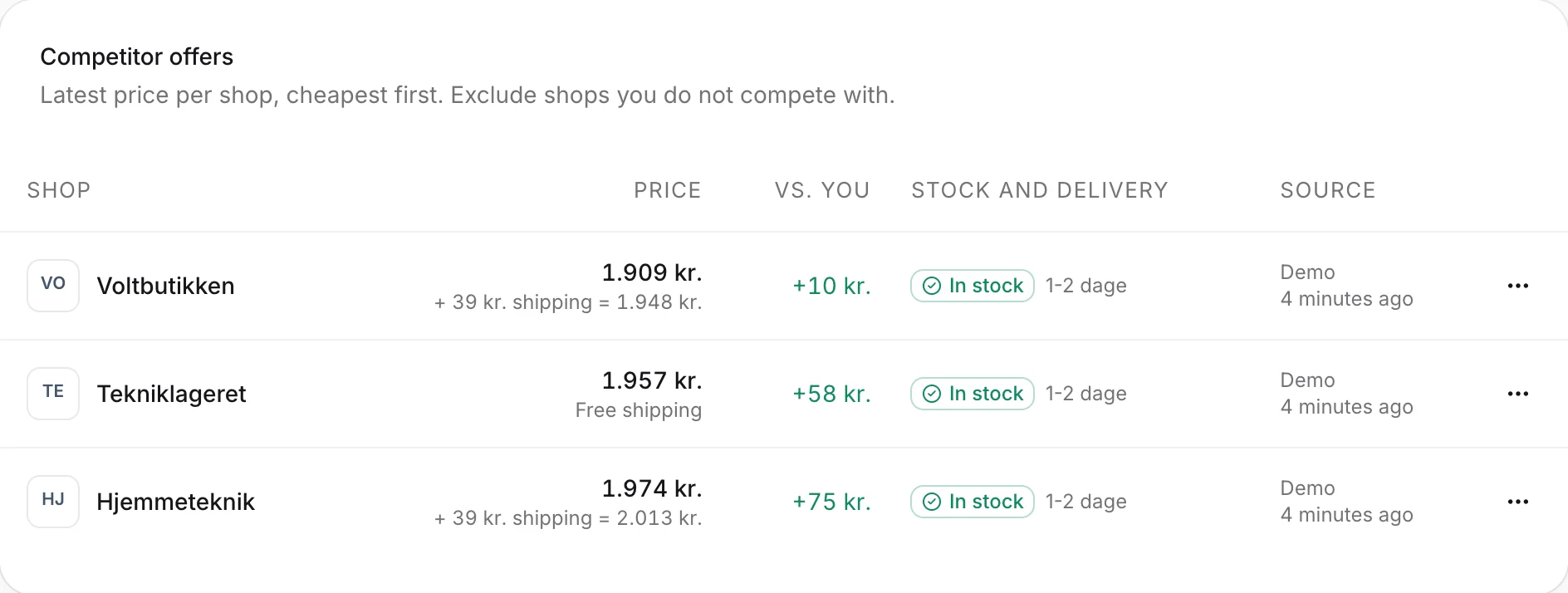
Every price comparison starts with a match: this product in my shop is that product in their shop. If the match is wrong, every number built on it is wrong too, from the price gap to the alert to the price a repricing rule sets. Matching is the least visible part of competitor monitoring and the one that decides whether the rest can be trusted.
The same product, three names
Here is one coffee grinder as it might appear in three shops. The product and names are made up, but the pattern is common:
- “KV-200 coffee grinder, black”
- “Electric coffee grinder 200W – black (KV200)”
- “Grinder KV 200 BLK incl. 2 brushes”
A person sees quickly that these are probably the same product. A program comparing names has to guess. Is “incl. 2 brushes” a bundle or just a description? Is “KV-200” the same as “KV 200”? And what about the KV-200S, the newer model with a different burr, listed as “KV-200 S coffee grinder black”?
Names are written for customers and search engines, not for matching. Shops shorten them, translate them, add selling points and change them during campaigns.
What an EAN is
An EAN (European Article Number, now part of the GTIN standard) is the number under the barcode on the packaging, usually 13 digits. It is assigned by the brand owner through GS1, and the last digit is a check digit calculated from the others.
What makes it useful for price comparison is that it is assigned per sellable unit:
- A black and a white version have different EANs.
- A single unit and a four-pack have different EANs.
- A new model has a new EAN.
Two shops listing the same EAN are, with very few exceptions, selling the same thing in the same pack.
Where name matching goes wrong
The errors from name matching are not random. They cluster in a few places.
Variants. Colour and size often sit at the end of the name or only in a dropdown. “Rain jacket, men’s” in size M and in size XL can share a name and a page.
Pack sizes. “Coffee filters no. 4” might be 80 filters in one shop and 4 × 80 in another.
Successor models. The old and the new model share most of their name and may be on sale at the same time while stock of the old one runs out.
Bundles. “Incl. case”, “with 2 batteries” or “starter kit” turns the same base product into a different offer.
A wrong match costs more than a gap
Example. The prices are made up to show the effect.
You sell a four-pack of filters at DKK 199. A name match pairs it with a competitor’s single pack at DKK 59. On paper the competitor is 70 % cheaper.
What follows:
- An alert says a competitor has undercut you by DKK 140.
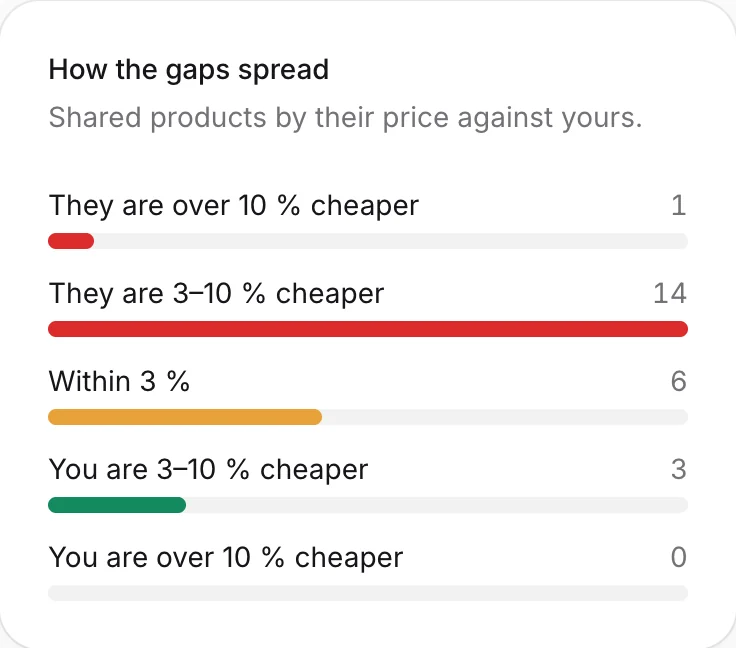
- Your price index against that shop drops by several points if you share few products.
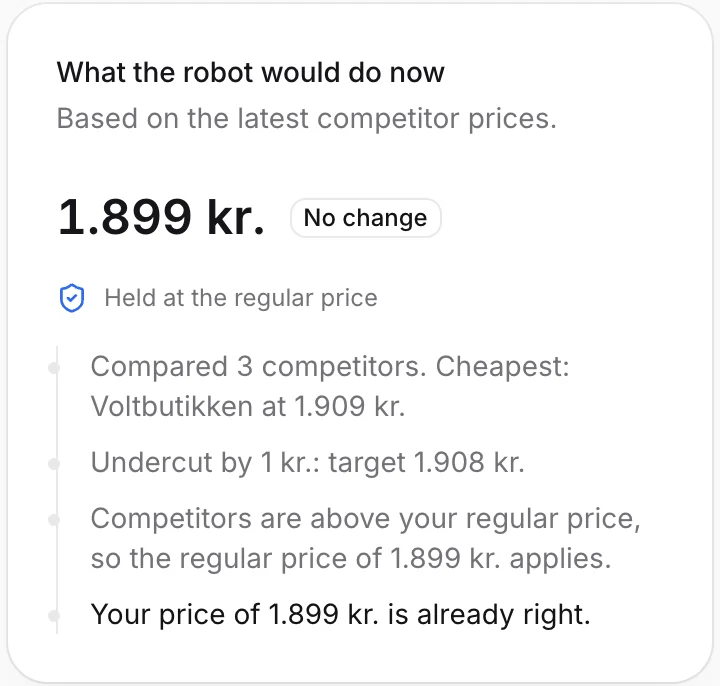
- If a repricing rule is active, it tries to follow, and only the minimum price stops it.
The reverse mistake is just as quiet: a competitor’s four-pack compared with your single unit makes you look far cheaper than you are, and you leave money on the table.
A missing match costs you one product you cannot see. A wrong match costs you a decision made on false numbers.
Where EAN matching falls short
EANs are not a complete answer.
- Not every shop publishes them. Many webshops include the EAN in the product data they send to Google, but not all do.
- Own brands and private labels often have no EAN, or one that only that shop uses.
- Marketplace listings sometimes carry the wrong EAN.
- Your own catalog may be missing EANs, especially for older products or products created by hand.
For these products you have to go by name, size, colour, price level and photo, and those matches need more care.
EAN first, then name and photo
Corprice uses the EAN where it can and falls back on the other evidence where it cannot.
With an EAN, it looks the product up on PriceRunner and gets every shop listed on that product page. Without one, it searches competitors’ catalogs and compares name, size, colour, price level and photo. Each match shows how sure Corprice is, and matches it is unsure of wait for your approval. A different size, colour or pack size is never counted as the same product.
You can also paste a competitor’s product page by hand when you know where the product is.
Getting EANs into your catalog
If many of your products lack EANs, filling them in is the single change that makes matching faster and safer.
- Most shop platforms have a field for it: the barcode on a Shopify variant, the GTIN field in WooCommerce, the EAN-13 field in PrestaShop. In Magento it is often a custom attribute.
- Supplier price lists and product feeds usually include the EAN.
- Accounting systems often have it too, as GTIN, barcode or EAN on the item.
Start with the products you sell most of. Those are the ones where a correct match matters most. Read more about price monitoring.