When to follow a competitor's price and when not to
A competitor lowers a price. Before you follow, check the offer, the shop and your own margin. A worked example and the cases where holding your price is the better choice.
Corprice5 min read
A competitor drops the price on a product you both sell. The reflex is to follow. Sometimes that is right. Often it gives away margin on sales you would have made anyway, or starts a round of cuts that ends with both shops earning less. Following should be a decision, and most of it can be made in advance.
First, check that it is the same offer
Before you compare prices, check what is behind the price.
- Is it the same product? Same model, colour, size and pack. A wrong match is the most common reason for a gap that is not real.
- Is it in stock? A shop that is sold out or on backorder is not taking the sale today.
- How long is delivery? A lower price with a week’s delivery is a different offer from next-day delivery.
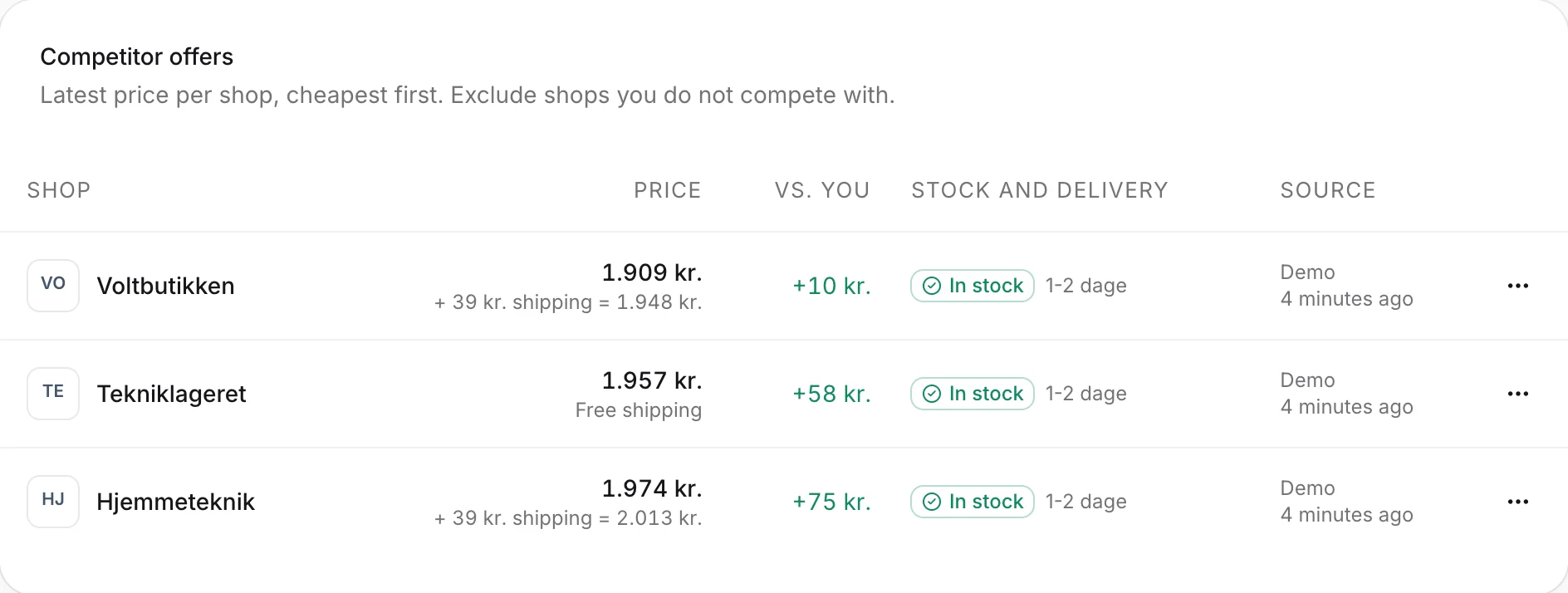
- What does shipping cost? The customer compares totals. See Shipping is part of the price.
- Is it a campaign? If the shop shows a before-price, the lower price is probably temporary.
A large share of “undercuts” disappear at this step.
Then, look at who it is
Not every shop’s price deserves the same response.
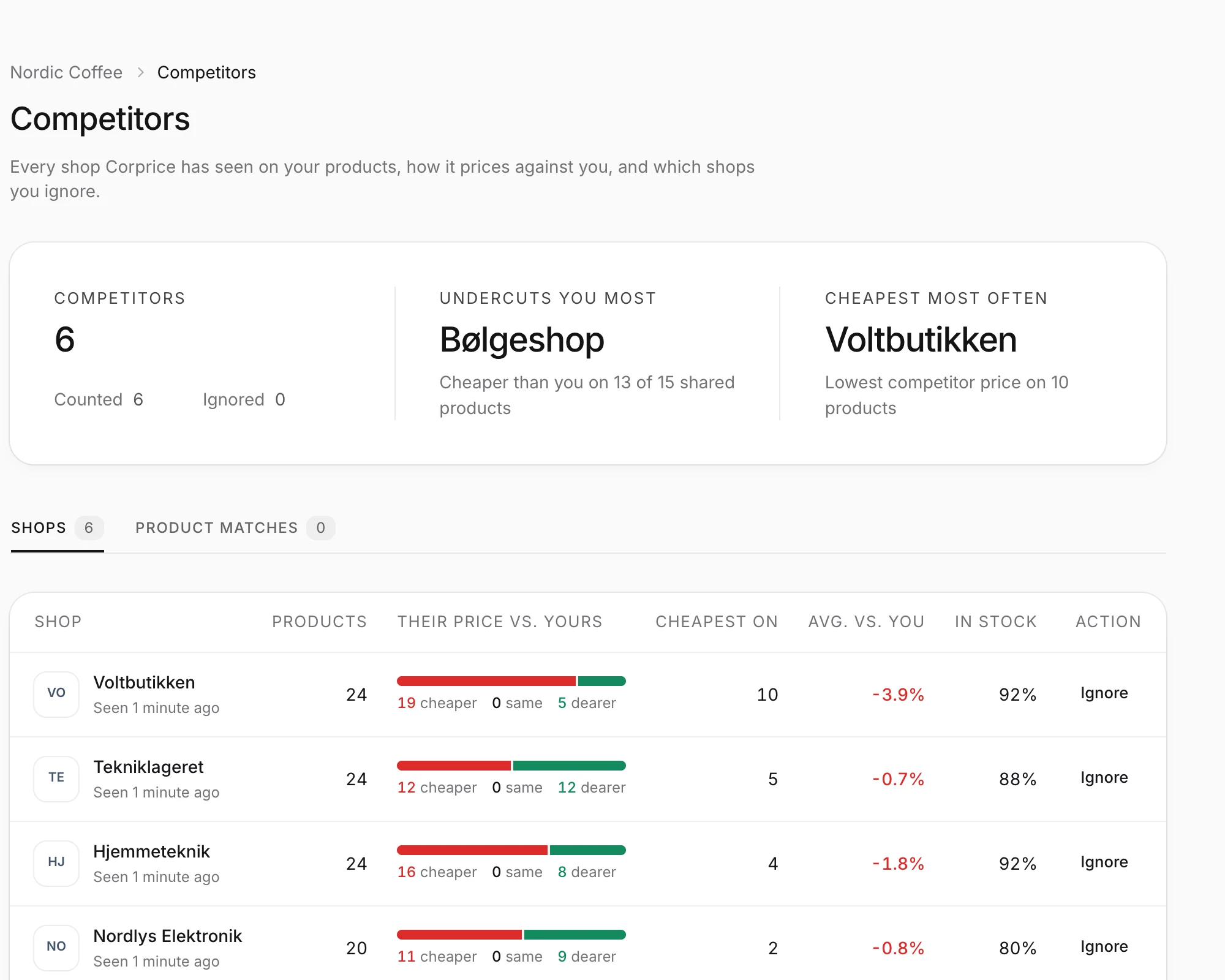
Shops that move first. Some competitors change prices and others follow within a few days. If this shop leads, its price is a signal of where the market is heading. If it usually follows others, its new price may simply be a reaction to someone else.
Marketplace sellers. A third-party seller on a marketplace with one unit left at a low price is a different competitor from a webshop with the product in stock.
Shops your customers do not consider. If a shop is in another country, sells mainly to businesses, or rarely shows up next to you on price comparison sites, its price matters less.
Do the arithmetic before you move
Lowering a price changes how much you earn per unit. The question is whether you will sell enough extra units to make up for it.
Example. The prices below are made up to show the method.
You sell an espresso machine at DKK 1,299 including VAT. Your cost price is DKK 850 including VAT. A competitor drops to DKK 1,199, in stock, with the same delivery and shipping as you.
| Price | Profit per unit excl. VAT | Margin | |
|---|---|---|---|
| Hold | DKK 1,299 | DKK 359.20 | 34.6 % |
| Go DKK 1 below | DKK 1,198 | DKK 278.40 | 29.0 % |
Profit per unit is (price − cost) ÷ 1.25. At DKK 1,198 you earn DKK 80.80 less on each machine. To earn the same in total, you need to sell 359.20 ÷ 278.40 = 1.29 times as many, about 29 % more units.
Ask whether being cheapest will bring that. On a product customers compare on price sites, it may. On a product people buy from you because of advice, service or a bundle, it probably will not.
When following makes sense
- The product is the same, the competitor has it in stock and delivers as fast as you.
- The shop is one your customers actually compare you with.
- The lower price is not a campaign, or the campaign is long enough to matter.
- The product is one where customers choose on price, typically well-known brands listed on price comparison sites.
- Your margin at the new price is still above your minimum.
When holding your price is the better choice
- It is a short campaign. Following a weekend campaign means lowering your price for a sale that ends before your customers notice.
- The competitor is sold out or on backorder. Their price does not affect today’s sales.
- The price is below your minimum. Either they buy cheaper than you, or they are clearing stock. Neither is a reason to sell at a loss.
- The old model is being cleared. Shops selling out a previous model often price it far below the new one.
- You win on something else. Faster delivery, free shipping at a lower limit, a longer return period or stock when others are out.
When to go up
The same logic works in the other direction. When the cheapest competitor raises its price or sells out, a discount you gave to stay cheapest may no longer be needed. Shops tend to watch for undercuts and miss these chances to earn more.
Make the decision once, as a rule
Most of this can be decided per product group in advance rather than case by case:
- Which competitors count, and which do not.
- Whether sold-out offers, backorders and long delivery times count.
- Whether to match, go below by an amount, or go below by a percentage.
- The minimum price, and how far the price may drop in one step.
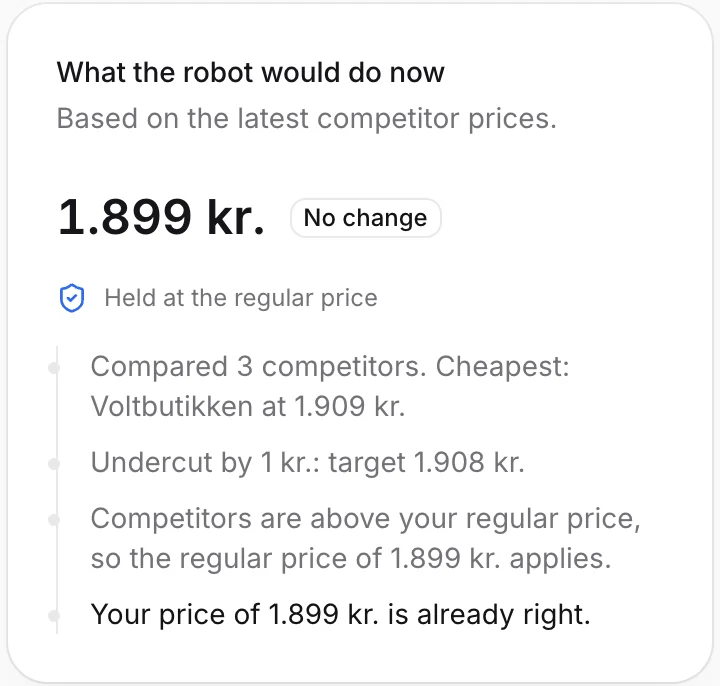
In Corprice, a repricing rule has three strategies: match the cheapest competitor, or go below it by an amount or a percentage. A rule can leave out sold-out offers, backorders, marketplaces or named shops, ignore offers older than a number of hours or with a delivery time above your limit, and stop at a minimum price, a largest discount and a largest drop per run. Prices never go above your regular price, and when competitors go up, Corprice removes its own discount. With approval on, every proposed price waits for you with the reason.
On the analysis side, Corprice shows who moves prices first (a change counts as leading when others make the same move on the same product within 72 hours), how fast each shop reacts to others, and campaigns from the moment a before-price appears.
See the repricing page for the rules and limits, or how to set a minimum price from your cost price.